Reading Notes
Every chart in Taiko no Tatsujin is built from a small number of note types. Once you understand what each note represents and how to play it, you’ll have everything you need to start playing any song you choose.
Unless otherwise stated, this guide describes the behaviour of the modern Nijiiro arcade version. Some mechanics differ slightly on home versions.
On this page
The Taiko Drum
Before learning the different note types, it’s important to understand how the taiko drum is played.
The drum has two playable areas:
- Surface (drumhead): used for don notes.
- Rim: used for ka notes.
Each area can be struck on either the left or right side, giving four possible inputs in total.
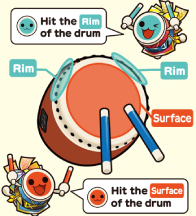
The rest of this guide uses surface and rim when referring to the playable areas of the drum.
The following abbreviations are also used:
- D = Don (surface)
- K = Ka (rim)
Every note in Taiko is simply a variation of one or both of these two inputs.
The drum used in Taiko no Tatsujin is based on the traditional Japanese taiko (太鼓), a family of percussion instruments that have been used in Japan for centuries.
Common Notes
These are the note types you’ll encounter most frequently while playing Taiko. Learning what each one represents is all you need to begin playing.
Don (ドン)

The don note is represented by a red circle.
Strike the surface of the drum when the note reaches the judgement circle.
Either side of the drumhead may be used.
Remember: red notes always represent don.
Ka (カ)

The ka note is represented by a blue circle.
Strike the rim of the drum when the note reaches the judgement circle.
Either side of the rim may be used.
Remember: blue notes always represent ka.
Drum Roll (連打)

Drum rolls begin with a yellow note followed by a yellow bar.
When the drum roll reaches the judgement circle, repeatedly strike the drum until the yellow bar ends.
Both don and ka hits count, so you may strike either the surface or the rim during a drum roll.
Drum rolls do not affect your combo. Missing a drum roll won’t cause a combo break.
Remember:
- Individual hit timing does not matter during drum rolls.
- Both don and ka hits count (though most players will only use don).
- Faster hits generally result in more points.
Large Notes

Large Notes are larger versions of the standard don, ka, and drum roll notes.
They are played on the same parts of the drum as their regular counterparts.
On Nijiiro arcade cabinets, the larger note indicates a strong strike. However, most arcade cabinets are configured with sensitivity settings that allow large notes to register with a normal-strength hit, so many players simply play them the same way as regular-sized notes.
On PC and console versions, large notes are played differently. Instead of using a strong strike, press both matching inputs at the same time. Using both inputs awards the highest possible score.
- Large don: Press both don inputs together.
- Large ka: Press both ka inputs together.
- Large drum rolls are played the same way as regular drum rolls, but award more points per hit.
See Scoring & Judgement for more information.
Balloon
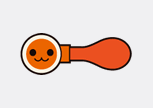
Balloon notes are represented by a red balloon displaying a number.
Balloons are similar to drum rolls, requiring repeated hits before the note ends. Unlike drum rolls, however, only don (surface) hits count towards the required total.
Strike the surface repeatedly until the displayed number reaches zero before the note ends.
The required number of hits is shown inside the Balloon. If the required number of hits isn’t reached before the note ends, the balloon simply won’t pop.
Uncommon Notes
Kusudama (Party Popper/Mallet)


Kusudama, referred to as Party Popper notes on arcade versions and appearing as Mallet notes on some console versions, function similarly to balloons.
Strike the surface of the drum repeatedly until the required number of hits has been reached before the note ends.
Hand-Holding Notes

Hand-Holding Notes only appear in certain 2-player charts.
When the note reaches the judgement circle, both players must strike their drum surfaces at the same time.
Hand-Holding Notes are exclusive to specific 2-player charts and can safely be ignored while learning the fundamentals of the game.
Reading Tips
- Ignore your score while learning to read charts. Focus on recognising the notes correctly first.
- Focus on note colour before note size.
- Look ahead to the right, rather than staring at the judgement circle.
- If you’re struggling to read a chart, try a lower difficulty first to become familiar with common note types.
- If you miss a note, keep reading the chart rather than trying to recover the missed hit.
Common Beginner Mistakes
- Confusing don (surface) and ka (rim) inputs.
- Watching the judgement circle instead of looking ahead.
- Hitting balloon notes only once.
- (PC/Console) Forgetting to use both matching inputs on large notes.
Read Next ➡️
🚧 taiko.guide is currently under active development.
Documentation is being added and expanded over time, so some sections may be incomplete or marked as work in progress.