Choosing a Controller
A drum controller lets you enjoy Taiko at home whenever you want, whether that’s playing casually after work, practicing difficult charts to build your skills, or preparing for your next Dan-i Dojo attempt at the arcade.
The best controller for you will depend on how you want to play. Some players simply want an affordable way to enjoy the game at home, while others want to recreate the feel of the arcade as closely as possible.
As with bachi, there isn’t a single “best” drum controller for everyone. Your ideal controller depends on your budget, platform, available space, and how closely you want to replicate the arcade experience.
On this page
- Why Buy a Drum Controller?
- Before You Buy
- Controller Categories
- Which Controller Is Right for Me?
- Where To Buy
- Common Beginner Mistakes
Why Buy a Drum Controller?
For many players, owning a drum controller, often referred to as a con, is the closest thing to having an arcade Taiko cabinet at home. While the game can be played using buttons, touch controls, or a standard game controller depending on the platform, a drum controller recreates the intended gameplay experience by letting you strike the drum just like you would in the arcade.
There are many reasons why players choose to buy a drum controller:
No Local Arcade
Not everyone has easy access to a Taiko arcade cabinet.
Some players live hours away from their nearest cabinet, while others don’t have one in their country at all. A home drum controller makes it possible to enjoy the game regularly without relying on occasional trips to the arcade.
Practice Between Arcade Sessions
Even if you mainly play at the arcade, a drum controller allows you to continue practicing at home. Many players use home play to improve consistency, learn difficult charts, or prepare for Dan-i Dojo before attempting the challenge on an arcade cabinet.
While no home setup perfectly replicates the arcade, practicing on a drum controller develops many of the same skills, including timing, stamina, stick control, and movement. As a result, these skills generally transfer much more effectively to arcade play than practicing with a standard game controller, keyboard, or touchscreen.
Play on Your Own Schedule
Travelling to the arcade isn’t always practical - even if you have a Taiko cabinet in your city, getting there can still take time. Whether it’s a drive across town, catching public transport, or fitting a visit around work, school, or other commitments, it’s not always possible to play whenever you want.
Instead of planning a trip to the arcade, you can simply play whenever it suits your schedule, whether that’s after work, after school, or even just for a quick 20-minute session. Being able to practice regularly also makes it easier to build and maintain your timing, stamina, and technique over time.
Bring the Arcade Home
For many players, a drum controller is simply the most enjoyable way to play.
Combined with a good setup, a drum controller recreates much of the feel of an arcade cabinet, making home play far more immersive than using buttons or a standard controller. For players who don’t have regular access to an arcade, it’s the closest experience to playing on a real machine.
Before You Buy
Before choosing a drum controller, it’s worth thinking about how and where you’ll actually use it.
Every controller is essentially a compromise between price, size, portability, and how closely it recreates the arcade experience. Taking time to consider the factors below will help you narrow down your options to find a controller that best suits your needs.
Which platform do you play on?
Not every controller supports every platform or game - some are designed specifically for Nintendo Switch, PlayStation, or Xbox, while others are intended primarily for PC. Some may also require additional adapters or community-made software to work on unsupported platforms.
Before purchasing a controller, make sure it’s compatible with both the platform and game version you intend to play.
If you’re planning to play Rhythm Festival on PS5, be especially careful. At the time of writing, the official PS5 HORI Drum Controller is the only controller that works natively with the PS5 version of the game. Many third-party controllers advertise “PS4/PS5 support”, but this refers to PS4 compatibility (including PS4 games running on a PS5), not native PS5 games such as Rhythm Festival.
Budget
Drum controllers range from more affordable entry-level models to premium arcade-style controllers costing several hundred dollars.
In general, spending more gives you a larger playing surface, better build quality, improved sensitivity, and a more arcade-accurate experience. However, a more expensive controller isn’t necessarily the right choice if you’re just starting out.
When comparing prices, remember to consider the total cost, not just the listed price. Shipping, import fees, and regional availability can make some controllers much more or less affordable depending on where you live.
Available Space
Think about where you’ll be playing and where you’ll keep your controller when you’re not using it.
Compact controllers can easily fit on a desk or small table and are simple to put away after each session. Most can be stored on a bookshelf, in a cupboard, or in other small spaces.
Arcade-style controllers require considerably more room. Their playing surface is approximately the same size as an arcade drum, making them much larger than compact controllers even before accounting for the legs or stand. While some models can be moved or stored when not in use, they’re generally intended to remain assembled, and many owners dedicate a permanent play area for them.
Before purchasing an arcade-style controller, make sure you have enough room to both use and store it comfortably.
Noise
Drum controllers can be quite loud, especially when played with wooden bachi.
However, noise levels vary considerably between different controllers. The drumhead material, the construction of the playing surface, and even the surface the controller sits on can all affect how much sound and vibration is produced.
If you live with family, roommates, or neighbours, it’s worth considering how much noise your setup may create before deciding on a controller.
Portability
If you plan to travel with your controller or regularly move it between rooms, portability may be an important consideration.
Compact controllers are generally much easier to transport and store, while arcade-style controllers are bulkier and better suited for a more permanent setup.
Arcade Accuracy vs Convenience
Finally, think about what matters most to you.
If your goal is simply to enjoy Taiko at home, a compact controller may be all you need. If you’re looking to recreate the arcade experience as closely as possible, an arcade-style controller will usually provide a more realistic size, feel, and playing surface, but at the cost of increased price, size, and reduced portability.
Controller Categories
While there are several drum controllers available, they can generally be grouped into two categories: compact and arcade-style. Each category offers different trade-offs in terms of price, size, performance, and how closely it recreates the arcade experience.
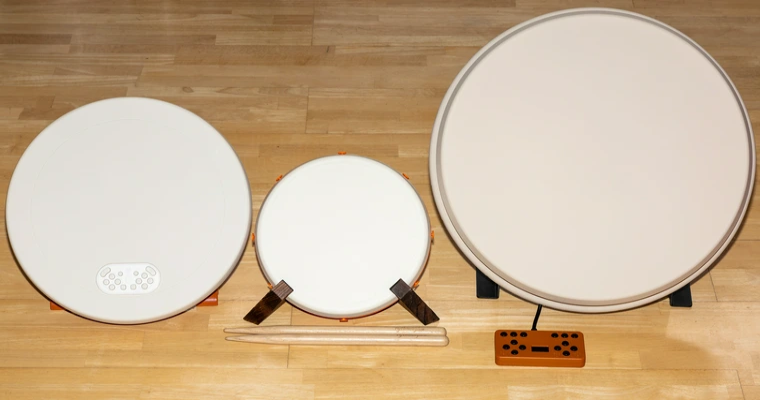
The photo below compares three popular controller sizes. While the TDC10 and IINE Pro Max are both considered compact controllers, the IINE Pro Max offers a noticeably larger playing surface. Arcade-style controllers, like the Taikoller, are significantly larger again, closely matching the size of a real Taiko arcade drum.
 |
|---|
| From left to right: IINE Pro Max, Rythmagica TDC10, and GAMO2 Taikoller. Photo courtesy of Reddit user u/Amaroko, used with permission. |
The following overview will help you understand the strengths of each category before looking at individual controllers.
Official Compact Controllers
Official controllers are manufactured by HORI under licence for home console releases of Taiko.
There are currently four official drum controllers:
- Nintendo Switch (released alongside Taiko no Tatsujin: Drum ‘n’ Fun!)
- PlayStation 4 (released alongside Taiko no Tatsujin: Drum Session!)
- PlayStation 5 / Windows PC (released alongside Taiko no Tatsujin: Rhythm Festival)
- Xbox Series X|S / Windows PC (released alongside Taiko no Tatsujin: Rhythm Festival)
Each controller is designed for its corresponding platform and game generation. Some controllers can also be used on other platforms through adapters, community software, or Steam Input. Compatibility and setup requirements vary, so it’s always worth checking before purchasing.
These are generally the most accessible option for new players. They offer native support for their intended platforms, are relatively affordable in many regions, and are a great starting point for casual play. However, they are considerably smaller than an arcade drum and are designed primarily for home use rather than replicating the arcade experience.
Other Compact Controllers
In addition to the official HORI drums, several other compact controllers are available from third-party manufacturers.
These controllers are designed for home play and generally remain much smaller and more portable than arcade-style controllers. Depending on the model, they may offer features such as a larger playing surface, improved sensitivity, multi-platform compatibility, replaceable parts, or user-upgradable firmware.
Current examples include:
- Rythmagica TDC10
- IINE Tatacon
- IINE Pro Max (sits between compact and arcade-style)
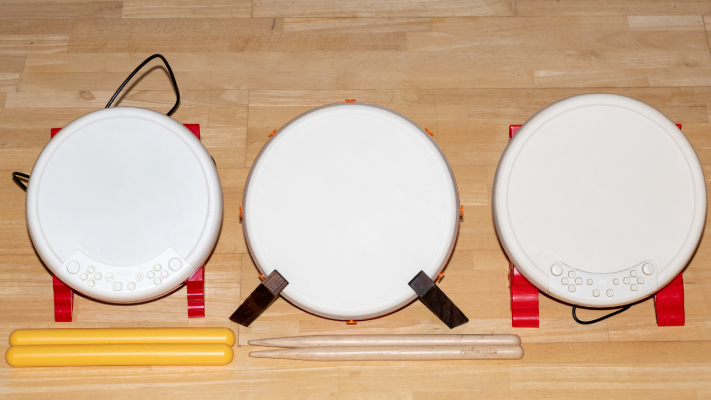
Because they are produced by different manufacturers, build quality, compatibility, and supported features can vary considerably. Some models are aimed at casual players looking for an upgrade over an official controller, while others are designed for enthusiasts who want more customisation and performance without moving to a full arcade-style controller.
 |
|---|
| From left to right: HORI drum for Nintendo Switch, Rythmagica TDC10, and IINE Tatacon. Photo courtesy of Reddit user u/Amaroko, used with permission. |
Arcade-style Controllers
Arcade-style controllers, also known as ASCs, are designed to recreate the look, feel, and playing experience of a real Taiko arcade cabinet as closely as possible. Unlike compact controllers, they feature a full-size playing surface comparable to an arcade drum, making them a popular choice for players who regularly practice at home or want the most authentic experience possible.
These controllers are typically built using higher-quality materials and offer excellent sensitivity, durability, and customisation. Many also use replaceable components, allowing parts such as the drumhead or sensors to be repaired or upgraded over time.
The trade-off is that they are significantly larger, heavier, and more expensive than compact controllers. They also require considerably more space and are generally intended to remain assembled rather than being packed away after each session.
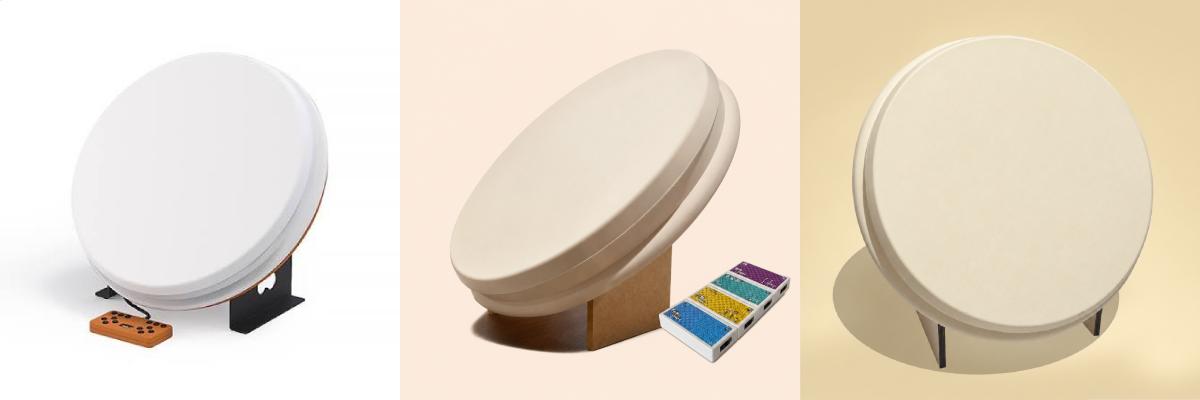
Current commercially available ASCs include:
- Taikoller
- Taiko Force Lv6
- ZhongTaiko
- TDC17
 |
|---|
| From left to right: GAMO2 Taikoller, YuanCon TaikoForce Lv6, and ZhongTaiko. |
Other projects also exist, including TaikoCatz and HanTaiko. These are generally produced in much smaller numbers or as community projects, making them less widely available than the controllers listed above.
DIY & Custom Controllers
Some players choose to build or modify their own drum controllers instead of purchasing a commercially available model.
DIY projects range from simple modifications to existing controllers through to fully custom arcade-style builds. They can offer excellent performance, customisation, and repairability, but typically require additional technical knowledge and are generally not recommended as a first controller.
If you’re interested in building or modifying your own controller, the community has produced a wealth of guides, documentation, and open-source projects.
Some of the best places to start include:
- Cons&Stuff Discord
- Rhythm Cons Wiki - has links to GitHub projects
Which Controller Is Right for Me?
There’s no single “best” controller for everyone. The right choice depends on how you plan to play, your available space, and your budget.
Now that you know the different types of controllers available, the recommendations below can help you decide which category best matches your situation.
I Mainly Play Casually
If you’re mainly playing for fun and don’t need an arcade-perfect experience, an official compact controller is usually the best place to start.
They’re affordable, widely available in many regions, easy to set up, and provide everything you need to enjoy the game at home.
I Mainly Practice for the Arcade
If you regularly play at the arcade or are working towards Dan-i Dojo, an ASC is the closest match to a real cabinet. Its full-size playing surface and similar feel help develop techniques and muscle memory that transfer naturally to arcade play.
If an ASC isn’t practical, another compact controller is still an excellent choice and will provide a more arcade-like experience than using buttons or a standard controller.
I Want the Closest Arcade (“Real”) Experience
An ASC controller is the closest you can get to owning a Taiko no Tatsujin cabinet at home.
These controllers are designed to closely replicate the size, feel, and playing experience of a real arcade drum, making them the preferred choice for dedicated players.
I Have Limited Space
Compact controllers are easy to place on a desk or table and can usually be stored away after each session. If you don’t have a dedicated play area, they’re generally the more practical choice.
I Travel Frequently
A compact controller is much easier to transport.
Whether you’re taking it to a friend’s house, a tournament, or simply moving it between rooms, compact controllers are significantly more convenient than ASCs.
I’m on a Tight Budget
The most affordable controller depends heavily on where you live.
Shipping costs, import fees, and local availability can significantly affect the final price, so don’t assume the cheapest recommendation from Reddit or YouTube will also be the cheapest in your region.
I Need Something That’s Quiet
There isn’t a single quietest controller.
Noise depends on many factors, including the controller’s construction, the material of the drumhead, the surface it’s placed on, and the type of bachi you’re using.
If noise is a concern, research the specific controller you’re considering and think about where you’ll be playing. Community reviews and videos can also give you a better idea of what a controller sounds like in real-world use.
I’m Happy to Modify or Tinker with My Controller
If you enjoy hardware projects, a DIY or custom controller may be worth exploring.
Many players modify existing controllers or build their own using community-developed hardware and software. This approach offers the greatest flexibility but usually requires considerably more time and technical knowledge than purchasing a ready-made controller.
Where To Buy
Drum controllers are sold through a variety of retailers depending on the manufacturer and where you live. Some are widely available through local stores, while others are only sold directly by the manufacturer or through import marketplaces.
Direct from the Manufacturer
Whenever possible, buying directly from the manufacturer or an authorised retailer is usually the safest option. You’ll generally receive the latest hardware revision, official warranty support, and access to firmware updates or documentation where available.
Many controllers, particularly arcade-style controllers, are only sold this way.
Local Gaming Retailers
Official HORI controllers are often stocked by major electronics and gaming retailers depending on your region.
Examples include stores such as JB Hi-Fi, Best Buy, EB Games/GameStop, and other local gaming retailers. Purchasing locally can make shipping, returns, and warranty claims much simpler than importing a controller from overseas.
Online Marketplaces
Many controllers are also sold through online marketplaces such as Amazon, AliExpress, and Taobao.
In some cases, the same controller is available from both the manufacturer and third-party sellers, often at different prices. It’s worth comparing multiple retailers before purchasing, as discounts, promotions, and shipping costs can vary significantly.
For example:
- IINE controllers are commonly sold through the official IINE store, AliExpress, and Taobao.
- Rythmagica controllers have also been available through Amazon in addition to the official Rythmagica website.
Second-hand Market
Second-hand marketplaces can be a great way to purchase discontinued controllers or save money.
When buying used, check the controller’s condition, included accessories, platform compatibility, and whether any modifications have been made.
Varied Availability by Region
The best-value controller can vary dramatically depending on where you live.
For example, official HORI controllers are often the most affordable option in parts of Asia. In other regions, however, shipping costs and import fees can make them similarly priced to higher-end third-party controllers.
Before deciding, compare the total cost, including shipping, taxes, and import fees, rather than relying solely on the advertised price.
Before purchasing, compare prices across local retailers, the manufacturer’s website, and trusted online marketplaces. Don’t forget to factor in shipping, import fees, taxes, and warranty support when deciding which option offers the best value.
Common Beginner Mistakes
There are a few common mistakes that are worth avoiding when you buy your first controller.
Buying Without Checking Compatibility
Not every controller works with every platform or game.
Before purchasing, always check that the controller supports both the platform and game version you intend to play. This is particularly important if you’re planning to play Rhythm Festival on PlayStation 5, as many controllers advertised as supporting “PS4/PS5” do not work with the native PS5 version of the game.
Thinking Bigger Always Means Better
ASCs offer the closest experience to a real Taiko cabinet, but they aren’t automatically the best choice for everyone.
They’re larger, heavier, more expensive, and require considerably more space than compact controllers. If you mainly play casually or have limited room, a compact controller may be the better fit.
Ignoring Noise
If you live with family, roommates, or neighbours, think about how much noise your setup may create. The controller itself, the surface it’s placed on, and the type of bachi you use can all affect the amount of sound and vibration.
Underestimating the Space Required
Before buying an ASC controller, make sure you have somewhere to use and store it.
Unlike compact controllers, ASCs are much larger and are generally intended to remain assembled. Many owners dedicate a permanent play area rather than packing them away after each session.
Focusing Only on the Purchase Price
The cheapest controller isn’t always the best value.
Shipping costs, import fees, taxes, and regional availability can significantly change the final price. Depending on where you live, a controller that appears cheaper at first may end up costing a similar amount to a more expensive alternative after all additional costs are considered.
If you’re still unsure, don’t overthink your first purchase. A controller that suits your budget, available space, and platform is almost always a better choice than chasing the “perfect” controller. As you gain more experience, you’ll naturally discover what features matter most to you.
Read Next ➡️
🚧 taiko.guide is currently under active development.
Documentation is being added and expanded over time, so some sections may be incomplete or marked as work in progress.